Clearing the UPSC Civil Services Examination (CSE) is not simply a test of how much a candidate can study. It tests conceptual understanding, analytical ability, decision-making, answer writing, time management and consistency across multiple stages.
The official UPSC schedule itself reflects how structured the examination journey is. For CSE 2026, the Preliminary Examination was scheduled for May 24, 2026, following notification and application stages earlier in the year.
Yet many aspirants who work hard for months or even years do not reach the final list.
The important question is therefore not “Why aren’t they studying enough?” but rather:
“Where is their preparation strategy breaking down?”
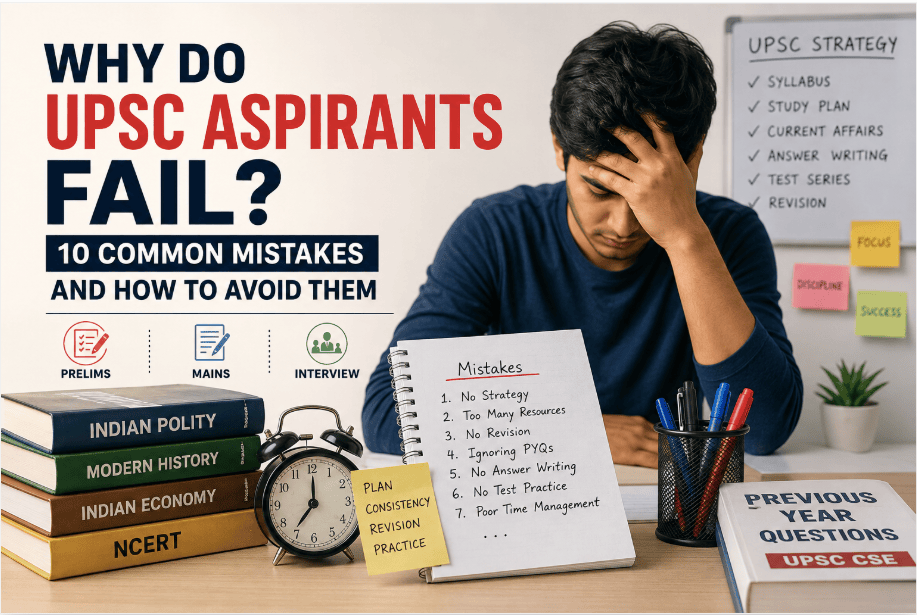
In most cases, failure is not caused by one mistake. It is a combination of poor resource selection, inadequate revision, insufficient practice, weak answer writing, inconsistent preparation and failure to analyse previous attempts.
This article examines 10 common UPSC preparation mistakes and, more importantly, explains how aspirants can correct them.
1. Studying Without Understanding the UPSC Syllabus
One of the biggest mistakes beginners make is starting preparation without properly reading the syllabus.
Aspirants often begin with NCERTs, standard books, newspapers and coaching material. They accumulate information but don’t always understand what UPSC actually expects them to know.
The syllabus should be treated as a framework for the entire preparation.
For example, instead of studying Indian Polity as an unlimited subject, a candidate should map preparation against the relevant General Studies syllabus areas and then connect those areas with previous-year questions.
How to avoid this mistake
Before starting serious preparation:
- Download the latest UPSC syllabus.
- Divide it into individual topics.
- Map important books and resources against each topic.
- Analyse previous-year questions.
- Maintain a topic-wise revision checklist.
- Periodically identify areas that remain weak.
This prevents preparation from becoming an endless cycle of reading.
2. Collecting Too Many Books and Study Materials
The internet has made UPSC resources extremely accessible.
That sounds helpful, but it can create another problem: resource overload.
An aspirant may have:
- Multiple polity books
- Several economy sources
- Different current-affairs magazines
- Telegram PDFs
- YouTube lectures
- Coaching notes
- Test-series material
- Topper notes
The result is often incomplete reading of everything and insufficient revision of anything.
The better approach
Follow a limited-resource strategy.
For each subject, identify:
One primary source + supplementary current affairs + PYQs + tests
The objective isn’t to read the maximum number of pages.
It is to reach the point where you can recall, analyse and apply information under examination conditions.
A useful question before adding a new resource is:
“Does this resource fill a genuine gap in my preparation, or am I simply looking for another explanation?”
If it doesn’t solve a specific problem, don’t add it.
3. Ignoring Previous-Year Questions
UPSC Previous-Year Questions (PYQs) are among the most valuable preparation resources.
Yet many aspirants treat them as something to solve only after completing the syllabus.
That approach can be inefficient.
PYQs help candidates understand:
- The type of concepts UPSC tests
- Recurring themes
- Question framing
- Analytical depth
- The difference between factual and conceptual preparation
- How static subjects connect with current affairs
How to use PYQs correctly
Don’t simply solve a question and check the answer.
Instead, ask:
Why did UPSC ask this?
Then identify:
- The syllabus topic
- The underlying concept
- The source from which it can be prepared
- Whether similar questions have appeared previously
- What additional dimensions could be asked
For Mains, PYQs should also be used for answer-writing practice.
4. Treating Long Study Hours as a Substitute for Productive Study
Another common misconception is:
More hours = higher probability of selection.
Not necessarily.
An aspirant can sit at a desk for 12 hours while spending substantial time on social media, repeatedly reading familiar material or watching lectures without active learning.
Another candidate might study for 7–9 genuinely focused hours with proper revision, tests and answer writing.
The second approach can be considerably more productive.
What should a productive day contain?
A serious preparation schedule could include:
- New concept learning
- Revision
- Current affairs integration
- PYQ practice
- Answer writing
- Prelims MCQs
- Optional preparation
- Test analysis
The exact number of hours should depend on the candidate’s stage, background and available time.
Instead of asking:
“How many hours do toppers study?”
ask:
“How many focused hours can I sustain consistently for the next 12 months?”
That is a much more useful metric.
5. Postponing Answer Writing Until Mains Is Near
This is particularly dangerous for first-time aspirants.
Many candidates spend months reading and making notes but don’t write answers because they believe:
“I’ll start answer writing after completing the syllabus.”
The problem is that answer writing is a skill, not merely an extension of knowledge.
A candidate has to learn how to:
- Understand the demand of the question
- Construct an introduction
- Organise arguments
- Use examples
- Present multiple dimensions
- Maintain balance
- Write within the word limit
- Reach a meaningful conclusion
- Manage time
These abilities require repeated practice.
A practical progression
A beginner could start with:
Stage 1: 1–2 answers occasionally
↓
Stage 2: 2–3 answers regularly
↓
Stage 3: Timed sectional practice
↓
Stage 4: Full-length Mains tests
The key is not merely writing.
It is writing → receiving feedback → identifying weaknesses → rewriting → improving.
6. Not Revising Enough
Aspirants frequently confuse completion with retention.
Finishing a 500-page book doesn’t mean you remember its contents.
UPSC preparation involves a massive volume of information, so forgetting is inevitable unless revision is deliberately scheduled.
A simple revision cycle
You can structure revision around:
First revision: Shortly after completing a topic
Second revision: After a few weeks
Third revision: Before major testing
Final revision: Close to the examination
The exact intervals can vary, but revision should be built into the timetable from day one.
One useful rule
Don’t measure preparation only by:
“How many chapters have I completed?”
Also measure:
“How much can I recall without looking at the book?”
That distinction is crucial.
7. Preparing Prelims and Mains as Completely Separate Exams
UPSC has different stages, but preparation should not become completely fragmented.
A candidate studying Indian economy, for example, should ideally understand:
- Static concepts
- Current developments
- Prelims factual/application questions
- Mains analytical dimensions
- Relevant government policies
- Examples and data
This creates integrated preparation.
However, as Prelims approaches, preparation naturally becomes more MCQ- and revision-oriented.
After Prelims, the emphasis shifts heavily toward Mains-specific writing, optional preparation and answer practice.
The solution
Build a common knowledge base first.
Then change the mode of application according to the examination stage.
8. Ignoring Test Analysis
Taking mock tests is only half the job.
The other half is analysing performance.
Suppose an aspirant scores 72 in a mock test.
The important question isn’t simply:
“Is 72 good or bad?”
Instead:
- How many questions were incorrect because of lack of knowledge?
- How many were incorrect because of poor elimination?
- How many were careless mistakes?
- Did time pressure affect performance?
- Were there specific weak subjects?
- Did the candidate attempt too many risky questions?
- Was there a recurring conceptual gap?
The same principle applies to Mains.
A test should identify a corrective action.
For example:
Weak Economy concepts → revise source + solve PYQs
Poor answer structure → practise introductions/conclusions
Slow writing → timed answer practice
Poor Prelims elimination → analyse incorrect options
This transforms testing from a marks-producing activity into a learning system.
9. Changing Strategy Too Frequently
UPSC preparation involves uncertainty, which makes aspirants vulnerable to strategy changes.
One week they follow a topper’s strategy.
The next week they discover a new YouTube channel.
Then someone recommends another book.
Then they hear that their optional subject is “too difficult.”
Eventually, preparation becomes a collection of unfinished strategies.
A better principle
Give a strategy enough time to produce evidence.
For example:
Strategy → Practice → Test → Analyse → Modify
Not:
Strategy → Internet advice → New strategy → New resources → Repeat
Changing direction is sometimes necessary, particularly after a failed attempt.
But changes should be based on performance data, not anxiety.
10. Failing to Diagnose Why a Previous Attempt Did Not Work
This is one of the biggest mistakes made by repeaters.
A candidate fails Prelims and immediately starts another cycle of preparation.
Or fails Mains and simply increases study hours.
But the real question is:
What exactly caused the failure?
For example, a candidate could have:
- Strong GS but weak CSAT
- Good knowledge but poor answer writing
- Good Mains preparation but weak Prelims revision
- Strong GS but weak optional
- Poor time management
- Inadequate test practice
- Weak current-affairs integration
- Inconsistent preparation
Each problem requires a different solution.
Create an attempt post-mortem
After an unsuccessful attempt, document:
| Area | Questions to Ask |
|---|---|
| Prelims | Was the issue knowledge, elimination or risk-taking? |
| Mains | Was answer structure or content the problem? |
| Optional | Was the subject adequately prepared? |
| Essay | Were arguments balanced and sufficiently developed? |
| Ethics | Were examples and case-study approaches adequate? |
| Time management | Could the paper be completed comfortably? |
| Revision | How many complete revision cycles were achieved? |
| Tests | Were mocks analysed properly? |
This turns failure into diagnostic information.
Top 3 IAS Coaching Institutes Aspirants Can Consider
Coaching is not mandatory for UPSC. Many candidates successfully prepare through self-study, while others benefit from structured classes, mentorship, evaluation and test series.
If an aspirant is considering coaching, three institutes worth researching are Legacy IAS, Vajiram & Ravi, and Vision IAS.
The ranking below should be viewed as a comparison for consideration, not an official UPSC ranking. UPSC itself does not rank coaching institutes.
1. Legacy IAS Academy
Legacy IAS Academy is based in Bengaluru and offers UPSC preparation through offline and online formats. Its current programs include Prelims, Mains and Interview preparation, along with mentorship, answer-writing practice and test-series support. The academy also highlights smaller batches and personalised mentorship as part of its approach.
This may be worth considering for aspirants who prefer:
- Structured preparation
- Personalised mentorship
- Smaller learning environments
- Answer-writing support
- Offline preparation in Bengaluru
- Online or weekend options
The important point is to evaluate the specific faculty, batch, course structure and mentorship support before enrolling.
2. Vajiram & Ravi
Vajiram & Ravi
Vajiram & Ravi is another established name in the UPSC coaching ecosystem.
Its current offerings include foundation preparation as well as mentorship and test-oriented programs. Its StepUp Mentorship program, for example, is specifically designed to address preparation gaps among experienced aspirants and includes structured guidance and performance monitoring.
Aspirants considering the institute should examine:
- Faculty for their chosen subjects
- Foundation course structure
- Test series
- Mentorship options
- Online/offline delivery
- Current course schedule
The right choice depends heavily on the candidate’s preparation stage.
3. Vision IAS
Vision IAS
Vision IAS offers a broad range of UPSC preparation resources, including foundation courses, Prelims and Mains test series, current affairs resources and mentorship programs. Its current test-series ecosystem also includes personalised assessment features designed to help aspirants identify strengths and weaknesses.
Its test-oriented preparation can be particularly relevant for candidates who want regular assessment and structured practice.
For example, Vision IAS describes its Prelims test series as including post-test analysis and personalised assessment, while its Mains offerings include tests and feedback-oriented components.
Again, candidates should compare the actual course they intend to join, rather than choosing an institute only because of its brand recognition.
Coaching vs Self-Study: What Should You Choose?
There is no universal answer.
Self-study may work well if you:
- Can create your own schedule
- Understand the syllabus
- Can select reliable resources
- Have strong discipline
- Can evaluate your own preparation
- Can arrange answer-writing and test evaluation
Coaching may be useful if you:
- Are starting from scratch
- Struggle with planning
- Need regular accountability
- Want structured classes
- Need answer evaluation
- Want mentorship
- Find it difficult to identify preparation gaps
There is also a third option:
Hybrid preparation
Many aspirants combine:
Self-study + coaching/test series + mentorship
This can be particularly useful when a candidate doesn’t need complete classroom instruction but needs external evaluation and structure.
A More Effective UPSC Preparation Framework
Instead of simply increasing study hours, build preparation around five pillars:
1. Syllabus
Know exactly what UPSC expects.
2. PYQs
Understand what UPSC has actually asked.
3. Limited Resources
Avoid unnecessary resource accumulation.
4. Practice
Regularly solve MCQs and write Mains answers.
5. Feedback
Use tests and evaluations to identify weaknesses and correct them.
The cycle should look like:
Study → Practice → Test → Analyse → Revise → Repeat
That is more sustainable than simply:
Study → Study → Study → Hope
Final Takeaway
UPSC failure is rarely about intelligence alone.
A candidate can be hardworking and still struggle if the preparation system has structural weaknesses.
The most common problems are:
- Not understanding the syllabus
- Collecting excessive resources
- Ignoring PYQs
- Confusing long hours with productive study
- Delaying answer writing
- Neglecting revision
- Separating Prelims and Mains preparation too much
- Taking tests without analysing them
- Frequently changing strategies
- Failing to diagnose previous attempts
The objective should therefore not be to study everything.
It should be to build a preparation system where every hour of study contributes to understanding, retention, application and exam performance.
Whether an aspirant chooses self-study or an institute such as Legacy IAS, Vajiram & Ravi or Vision IAS, the final responsibility remains with the aspirant: selecting the right resources, practising consistently, analysing mistakes and improving from one test to the next.
In a competitive examination like UPSC, consistent course correction is often more valuable than simply working harder.

